Bioinformatics & Sequence Learning
Machine Learning
Bioinformatics
N-gram and signal-processing methods for DNA and protein sequences: subcellular localization, genome assembly, phylogenetics, and contact maps.
My research career began in bioinformatics. The common thread is treating biological sequences as language or as signals, and learning from them at scale.
- ngLOC: an n-gram Bayesian method for predicting where proteins live in the cell, with Dr. Chittibabu Guda (Genome Biology 2007). Alex Barteau ’13 helped turn it into released software and a web server (BMC Research Notes 2012).
- De novo assembly: Matt Segar ’12 developed an n-gram probabilistic method for assembling next-generation sequencing reads. It became his Miller Prize–winning honors thesis and an ISMB 2012 poster.
- Alignment-free phylogenetics (ngPhylo) with Brigitte Hofmeister ’14, and protein contact-map prediction with Rachel Ren ’15. Both were presented at ACM BCB.
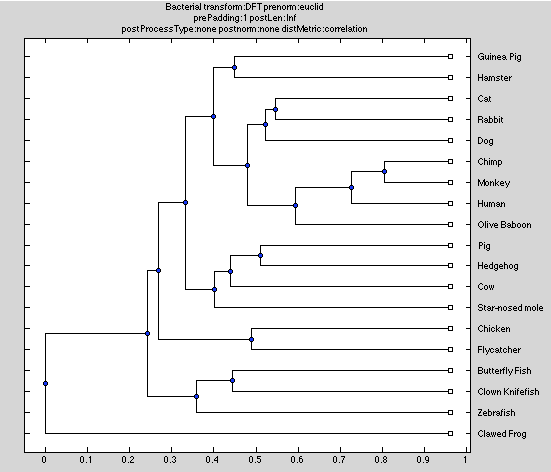
- Genomic signal processing: with Prof. Maurice Aburdene (ECE) and students, we used the discrete Fourier transform to compare genes across species (EURASIP JBSB 2014).
Geisinger collaborations applied these ideas to clinical genomics: deploying caBIG for cancer research with Dr. Gerard Tromp, and copy-number dosage maps with Dr. Abby Hare-Harris (ASHG 2015 Reviewer’s Choice).
Back to top